
 What are the differences between irradiated pearls and dyed pearls?
There are several differences between irradiated pearls and dyed pearls, as follows:
Color Modification Principle
Irradiated Pearls: Pearls are irradiated using rays, high-energy electron beams, or neutron reactors. When high-energy particles pass through the aragonite crystals inside the pearls, various lattice defects are generated within the crystals, inducing new color centers and thus causing a change in color. Usually, the nuclei of white or light-colored pearls are turned into gray, black, etc., so that the entire pearl presents the corresponding color through the transparent or translucent pearl layer.
Dyed Pearls: By immersing pearls in a chemical dye solution, the dye is adsorbed on the surface of the pearls or penetrates into the interior of the pearls, thus changing the color of the pearls. There is also a method in which the pearl nucleus is dyed and then implanted into the shellfish body, making the formed pearl show the color of the nucleus, but this method is less common.
Color Characteristics
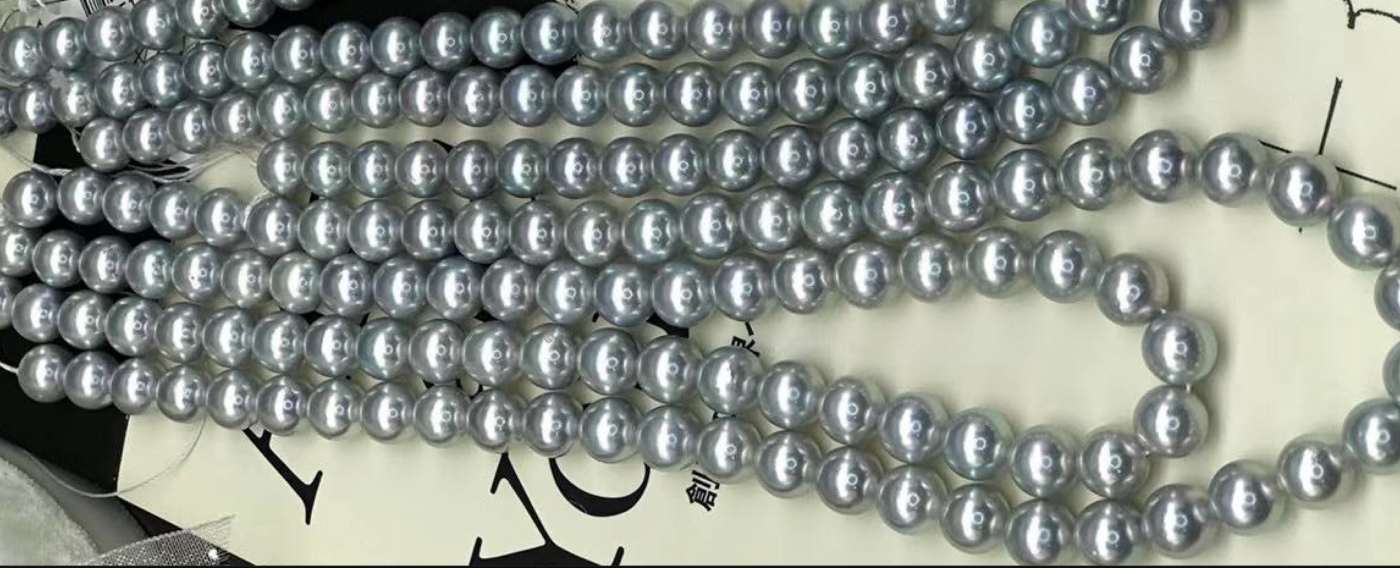
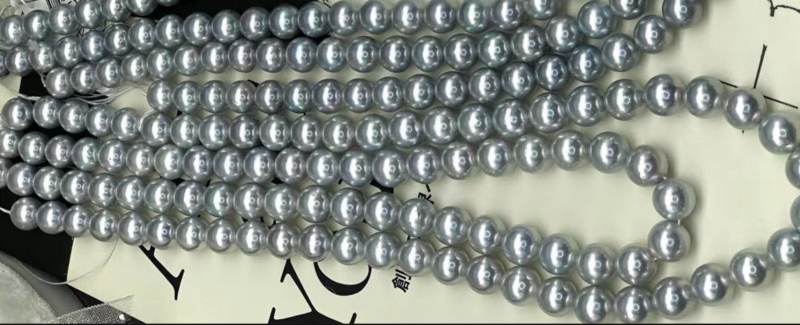
Irradiated Pearls: The color is relatively uniform, and the surface color is evenly distributed, often showing the phenomenon of interference halos. The secondary color halos of some irradiated and color-modified pearls are rich and vivid, and they are accompanied by a metallic luster. However, the color is uniform, and there is no diversity of the secondary colors of cultured pearls. However, the natural gray Akoya pearls are grayish-blue because there are black organic matters interspersed between the pearl layer and the pearl nucleus, and there are uneven color patches, which is different from irradiated pearls.
Dyed Pearls: The color often appears dull and unnatural, and there may be uneven color. There is often a concentration of color at the defective parts, drilling holes, or cracks on the surface of the pearls, forming small color patches or spots. For some inferior dyed pearls, the traces of the string being dyed between the pearl grains can be seen with the naked eye.
Internal Structure
Irradiated Pearls: The nuclei of nucleated irradiated pearls are black. When illuminated with strong light or observed through the hole, it can be found that the nucleus is dark in color, while the pearl layer is relatively light in color, usually grayish-white.
Dyed Pearls: Under a microscope, circular, dot-shaped, and flaky patterns formed by the uneven diffusion of the dye can be seen inside the pearls. When illuminated with light, there will be small granular color patches inside the dyed pearls, which are caused by the accumulation of pigments in the pearl layer.
Stability and Safety
Irradiated Pearls: The color is stable and generally does not fade. The irradiation dose of pearls is small, equivalent to the intensity of normal rainwater, which is far below the national safety exemption standard and will not cause harm to the human body.
Dyed Pearls: The color of some dyed pearls has poor stability. Over time or under certain environmental conditions, they may fade. Some dyes may contain harmful chemical substances, and long-term wearing may pose potential hazards to human health.
Difficulty of Identification
Irradiated Pearls: Identification is relatively difficult. The natural color and the irradiated color show highly similar characteristics in conventional tests such as Raman spectroscopy and XRD diffraction. Only a few laboratories can accurately identify them by detecting the valence state changes of elements through synchrotron radiation XANES technology.
Dyed Pearls: Through a variety of methods such as magnified observation, luminescence image analysis, composition analysis, ultraviolet-visible spectroscopy analysis, and Raman spectroscopy analysis, dyed pearls can generally be identified accurately. In actual identification, it is also possible to make a preliminary judgment by observing the color characteristics and whether there is pigment accumulation at the drilling holes.

Got a question about a product ? Need someone to help guide you through our website ?
Got feedback? Go to BAOYUE Pearl Education page to read some relevant articles about pearls.
For Normal Questions, please check FAQ , and for other question, feel free to Contact Us , we make it easy for you to get in touch with us !