In recent years, the quality of Chinese freshwater pearls has significantly improved. With technological innovations in aquaculture and standardized management, they have occupied an important position in the global market. The following analyzes their quality characteristics from multiple dimensions:
I. Pearl Shape and Luster
Shape Regularity
Traditional freshwater pearls are mainly "near-round," with a low round bead rate in the early days (about 30%). However, through improved mussel species (such as optimization of Hyriopsis cumingii) and upgraded aquaculture techniques (such as precise nucleation and density control), the proportion of near-round and perfectly round pearls has now increased to 40%-50%, and some high-end production areas (such as Zhuji, Zhejiang) can reach over 60%.
Special varieties like "Edison pearls" can produce 10-20mm super-large round pearls with shape regularity close to that of saltwater pearls by implanting large-sized bead nuclei.
Luster
Freshwater pearls are characterized by soft and warm luster, with high surface smoothness and significant specular reflection. The luster intensity (thickness of the pearl layer) of high-quality pearls can reach 0.3-0.8mm (internationally, more than 0.3mm meets the commercial jewelry-grade standard), and some fine products approach the "cool luster" of saltwater pearls.
The improvement in luster benefits from water quality optimization (such as microfiltration membrane purification technology) and extended aquaculture cycles (from the traditional 1-2 years to 3-5 years).
II. Color and Category Diversity
Rich Basic Color Palette
Chinese freshwater pearls cover white, pink, purple, gold, black and other main colors, among which:
White series: Accounting for about 50%, including off-white, blue-white, silver-white and other subdivisions, suitable for daily wear;
Pink series: Soft and romantic, accounting for about 30%, a popular choice among young consumers;
Purple series: Unique and mysterious, mainly produced in Hunan, Jiangxi and other production areas, accounting for about 10%;
Colored Edison pearls: Special aquaculture techniques can produce rare colors such as deep purple, bronze, and peacock green to meet personalized needs.
Advantages of Special Varieties
Edison pearls: As a domestically developed freshwater pearl variety in China, they feature "large size, strong luster, and rich colors." The diameter of a single pearl is generally ≥10mm, with the largest exceeding 20mm. Their luster is comparable to that of South Sea golden pearls, but the price is only 1/3-1/2 of that of saltwater pearls of the same specification.
Baroque pearls: With natural irregular shapes, they have become popular among designer brands in recent years due to the "asymmetrical aesthetics" trend. China produces more than 70% of the world's baroque pearls, with unique surface textures that can be used to create highly artistic jewelry.
III. Quality Control and Industry Standards
Standardized Aquaculture System
Main production areas such as Zhuji, Zhejiang, and Suzhou, Jiangsu, have implemented "watershed grid management", monitoring water quality (pH value, dissolved oxygen, ammonia nitrogen content, etc.) and controlling aquaculture density (≤800 mussels per mu) to reduce diseases and improve pearl consistency.
Some enterprises have introduced digital aquaculture technologies, such as intelligent feeding systems and real-time water quality monitoring apps, to achieve precise control of the aquaculture process.
Grading and Certification System
The Gemstone and Jewelry Industry Association of China (GAC) has formulated grading standards for freshwater pearls, dividing pearls into top-grade, high-quality, and ordinary levels based on five dimensions: color, luster, smoothness, shape, and size, promoting market standardization.
Leading enterprises such as "Nuangshi Pearls" and "Shanxiahu Pearls" have passed ISO 9001 quality management system certification and established pearl testing laboratories. Each pearl must pass inspections by equipment such as luster meters and pearl layer thickness detectors before leaving the factory.
IV. Comparative Advantages with Saltwater Pearls
Dimension
Chinese Freshwater Pearls
Saltwater Pearls (e.g., South Sea Pearls, Akoya)
Price
Affordable (1/3-1/2 the price of saltwater pearls of the same specification)
Expensive (a single 10mm South Sea pearl costs over 10,000 RMB)
Output
Account for over 95% of global freshwater pearls
Scarce output (limited by sea areas and mother-of-pearl quantity)
Color Richness
Diverse color systems with unique colored varieties
Relatively single color (South Sea pearls are mainly gold and white)
Application Scenarios
Daily wear, fashion design
High-end collection, classic jewelry
V. Market Feedback and International Recognition
Domestic Consumption Upgrading: With the rise of "national trend," the penetration rate of freshwater pearls among young groups has increased. In 2023, the sales volume of pearl categories on Tmall increased by 45% year-on-year, with freshwater pearl accessories accounting for over 60%.
International Competitiveness: Chinese freshwater pearls are exported to more than 50 countries in Europe, America, Japan, etc. Their market share in Japan has increased from 30% in 2010 to 55% in 2023, gradually replacing part of the low-end saltwater pearl market with high cost-effectiveness.
Design Empowerment: Brands such as Chow Tai Fook and TSL have launched high-end lines of freshwater pearls (such as "Chow Tai Fook · Zhen"), enhancing the luxury attributes of freshwater pearls through setting techniques (such as cluster setting and layered design), breaking the inherent impression that "freshwater pearls are low-end."
Got a question about a product ? Need someone to help guide you through our website ?
Got feedback? Go to BAOYUE Pearl Education page to read some relevant articles about pearls. For Normal Questions, please check FAQ , and for other question, feel free to Contact Us , we make it easy for you to get in touch with us !
What are the differences between irradiated pearls and dyed pearls?
There are several differences between irradiated pearls and dyed pearls, as follows:
Color Modification Principle Irradiated Pearls: Pearls are irradiated using rays, high-energy electron beams, or neutron reactors. When high-energy particles pass through the aragonite crystals inside the pearls, various lattice defects are generated within the crystals, inducing new color centers and thus causing a change in color. Usually, the nuclei of white or light-colored pearls are turned into gray, black, etc., so that the entire pearl presents the corresponding color through the transparent or translucent pearl layer. Dyed Pearls: By immersing pearls in a chemical dye solution, the dye is adsorbed on the surface of the pearls or penetrates into the interior of the pearls, thus changing the color of the pearls. There is also a method in which the pearl nucleus is dyed and then implanted into the shellfish body, making the formed pearl show the color of the nucleus, but this method is less common.
Color Characteristics Irradiated Pearls: The color is relatively uniform, and the surface color is evenly distributed, often showing the phenomenon of interference halos. The secondary color halos of some irradiated and color-modified pearls are rich and vivid, and they are accompanied by a metallic luster. However, the color is uniform, and there is no diversity of the secondary colors of cultured pearls. However, the natural gray Akoya pearls are grayish-blue because there are black organic matters interspersed between the pearl layer and the pearl nucleus, and there are uneven color patches, which is different from irradiated pearls. Dyed Pearls: The color often appears dull and unnatural, and there may be uneven color. There is often a concentration of color at the defective parts, drilling holes, or cracks on the surface of the pearls, forming small color patches or spots. For some inferior dyed pearls, the traces of the string being dyed between the pearl grains can be seen with the naked eye.
Internal Structure Irradiated Pearls: The nuclei of nucleated irradiated pearls are black. When illuminated with strong light or observed through the hole, it can be found that the nucleus is dark in color, while the pearl layer is relatively light in color, usually grayish-white. Dyed Pearls: Under a microscope, circular, dot-shaped, and flaky patterns formed by the uneven diffusion of the dye can be seen inside the pearls. When illuminated with light, there will be small granular color patches inside the dyed pearls, which are caused by the accumulation of pigments in the pearl layer.
Stability and Safety Irradiated Pearls: The color is stable and generally does not fade. The irradiation dose of pearls is small, equivalent to the intensity of normal rainwater, which is far below the national safety exemption standard and will not cause harm to the human body. Dyed Pearls: The color of some dyed pearls has poor stability. Over time or under certain environmental conditions, they may fade. Some dyes may contain harmful chemical substances, and long-term wearing may pose potential hazards to human health.
Difficulty of Identification Irradiated Pearls: Identification is relatively difficult. The natural color and the irradiated color show highly similar characteristics in conventional tests such as Raman spectroscopy and XRD diffraction. Only a few laboratories can accurately identify them by detecting the valence state changes of elements through synchrotron radiation XANES technology. Dyed Pearls: Through a variety of methods such as magnified observation, luminescence image analysis, composition analysis, ultraviolet-visible spectroscopy analysis, and Raman spectroscopy analysis, dyed pearls can generally be identified accurately. In actual identification, it is also possible to make a preliminary judgment by observing the color characteristics and whether there is pigment accumulation at the drilling holes.
Got a question about a product ? Need someone to help guide you through our website ?
Got feedback? Go to BAOYUE Pearl Education page to read some relevant articles about pearls. For Normal Questions, please check FAQ , and for other question, feel free to Contact Us , we make it easy for you to get in touch with us !
The differences in the formation processes of freshwater pearls and seawater pearls are as follows:
Stimulus Source Freshwater Pearls: In the natural environment, it may be caused by foreign objects such as sand grains or parasites that accidentally enter the mussel. In artificial cultivation, small pieces of the mussel's mantle are usually cut and implanted into the mantle tissue of another mussel to serve as a stimulus source, prompting it to secrete nacre. Seawater Pearls: In their natural state, they may be caused by tiny organisms or sand grains in the ocean entering the shellfish. For the artificial cultivation of seawater pearls, a pearl nucleus made of clam shells or other materials is implanted into the shellfish as the core for pearl formation, stimulating the shellfish to secrete nacre.
Secretion Process Freshwater Pearls: Taking the Hyriopsis cumingii as an example, when a foreign object appears in its body, it will gradually secrete nacre, producing only a small piece at a time. Over time, these thin flakes of nacre gradually accumulate, enveloping the foreign object to eventually form a pearl. Seawater Pearls: After being stimulated by the pearl nucleus or foreign objects, the epithelial cells of the mantle of the shellfish will quickly secrete nacre, precipitating layer by layer around the pearl nucleus or foreign object to form a pearl layer on the surface of the pearl nucleus, thus forming a pearl.
Formation Time Freshwater Pearls: Generally, nucleated freshwater pearls have a relatively longer growth cycle, usually taking 3 to 5 years or more; non-nucleated freshwater pearls usually have a growth cycle of 2 to 3 years. Seawater Pearls: The growth cycle is generally 1 to 3 years. For example, Tahitian pearls and South Sea pearls may have a growth cycle of 2 to 3 years, while Japanese seawater pearls have a relatively shorter growth cycle of about 1 to 2 years.
Involved Shellfish Freshwater Pearls: Mainly cultivated by freshwater mussels, such as Hyriopsis cumingii and Cristaria plicata. Seawater Pearls: Produced by marine shellfish, such as Pinctada martensii, Pinctada maxima and Pinctada margaritifera.
Pearl Quantity Freshwater Pearls: Typically, one freshwater mussel can produce multiple pearls. Seawater Pearls: Generally, one seawater shellfish can mostly produce only one pearl.
Got a question about a product ? Need someone to help guide you through our website ?
Got feedback? Go to BAOYUE Pearl Education page to read some relevant articles about pearls. For Normal Questions, please check FAQ , and for other question, feel free to Contact Us , we make it easy for you to get in touch with us !
Recently, CCTV's "County on the Departure·Jiangxi" program checked in many treasure counties and districts in Jiangxi. Under the camera, Duchang, the "hometown of freshwater pearls in China", where migratory birds dance and dolphins jump, is impressive.
Through the lens of CCTV, people have experienced the prosperous development of the pearl shell industry in Duchang. On the shore of Poyang Lake, how did a small pearl shell transform into a pillar industry that enriches the people and strengthens the county? What is the development story behind this pearl?
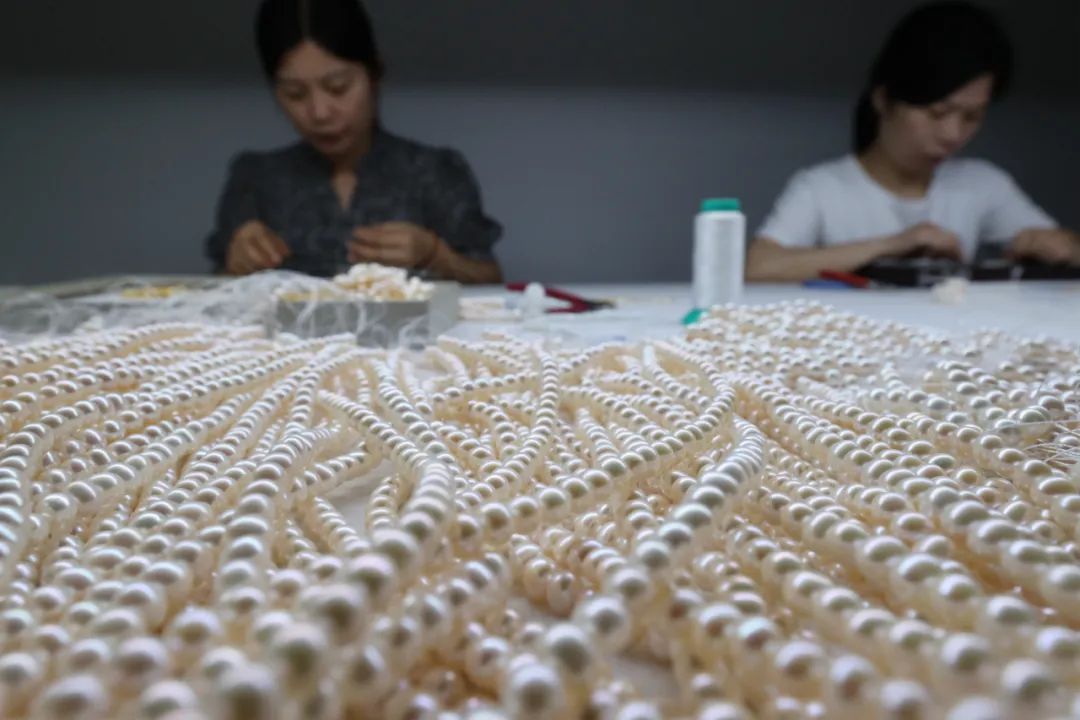
Workers are processing pearl jewelry in the pearl production workshop
One
From the "Huaiyi Binzhu and fish" recorded in "Shangshu·Yugong", the earliest historical document in my country, to the "bright moon pearl, out of the river and sea, hidden in the clam" described in "Historical Records·Turtle Strategy Biography", the story of pearls has a long history.
Pearls have many meanings such as "glory and good luck, wealth and treasures, auspiciousness and peace, reproduction and rebirth", which embody people's beautiful expectations. Whether it is the pearl jewelry that is indispensable to the upper class in the film and television work "The Great Gatsby", or the modern pearl makeup of Yang Zi and Jiang Mengjie in "Modern No. 9" and "Harper's Bazaar", people have a special liking for pearl jewelry.
The pearl cultivation area in Duchang County is about 15,000 acres, and the pearl production in 2019 was 42 tons, accounting for about 19.2% of the total freshwater pearl production in the province and 6.8% of the total freshwater pearl production in the country. The reputation of "China's Freshwater Pearl Hometown" is well-deserved.
Duchang has one-third of the water surface of Poyang Lake and is located in the core area of the world's famous lakes. As a large lakeside county, Duchang, which relies on water for food, has a wonderful story with freshwater pearls.
As early as the beginning of the 20th century, many towns in Duchang used shells to process button blanks. At the end of the last century, the pearl shell processing industry in Duchang experienced a period of rapid development, from the initial single button blank processing to pearl farming, pearl core processing, shell jewelry, shell crafts and interior decoration materials, and the scale of the industry continued to grow.
Among them, Zhouxi Town is a typical representative. In the 1960s and 1970s, Zhouxi Town had nearly 20 township-run key button factories. By the mid-1990s, 30% of the 50,000 people in the town were engaged in the processing and sales of pearl cores. In 1998, Zhouxi people began freshwater nucleated pearl farming again, and in 2005 they were awarded the title of "Hometown of Freshwater Pearls in China".
Since then, with the continuous improvement of industrial strength, Duchang has taken the construction of Poyang Lake Ecological Economic Zone as an opportunity to integrate Poyang Lake culture, pearl shell culture, and ecological harmony culture, and work together to create a characteristic cultural brand of Duchang County.
From one point to one side, from one town to one county. In a few years, thousands of pear trees are in bloom. An industrial development system led by the brand of "Ecological Duchang, Poyang Pearl Shell ", linked by high-quality "freshwater pearl" varieties, based on scale operation and supported by standardized production has gradually taken shape.
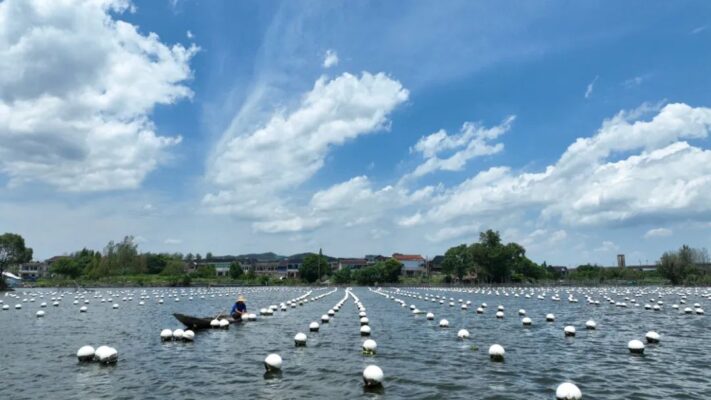
Workers are busy at the freshwater pearl breeding base
Two
Looking through the development history of Duchang pearl shell industry, it is not difficult to find that the transformation and rise of the pearl shell industry is inseparable from the pearl shell people who dare to think and fight.
Generations of pearl shell people have worked tirelessly to support the magnificent dreams of small shells.
"Only by turning the shells into treasures can the pearl shell industry have a long-term development." Under the leadership of a group of pearl shell leaders, Duchang pearl shells have gone through the initial stage of breeding and rough processing, and are constantly moving towards the middle and high end of the industrial chain.
BAOYUE Pearl is committed to providing the world pearl market with high-quality and low-cost freshwater pearl strand . Our company adheres to the concept of: developing industry, strengthening platform, and seeking innovation. Today, a pearl shell industry cluster integrating product research and development, industry standard testing, production and sales, and cultural experience is becoming more mature. Relying on this industry, Duchang's new road of "beautiful economy" is getting wider and wider.
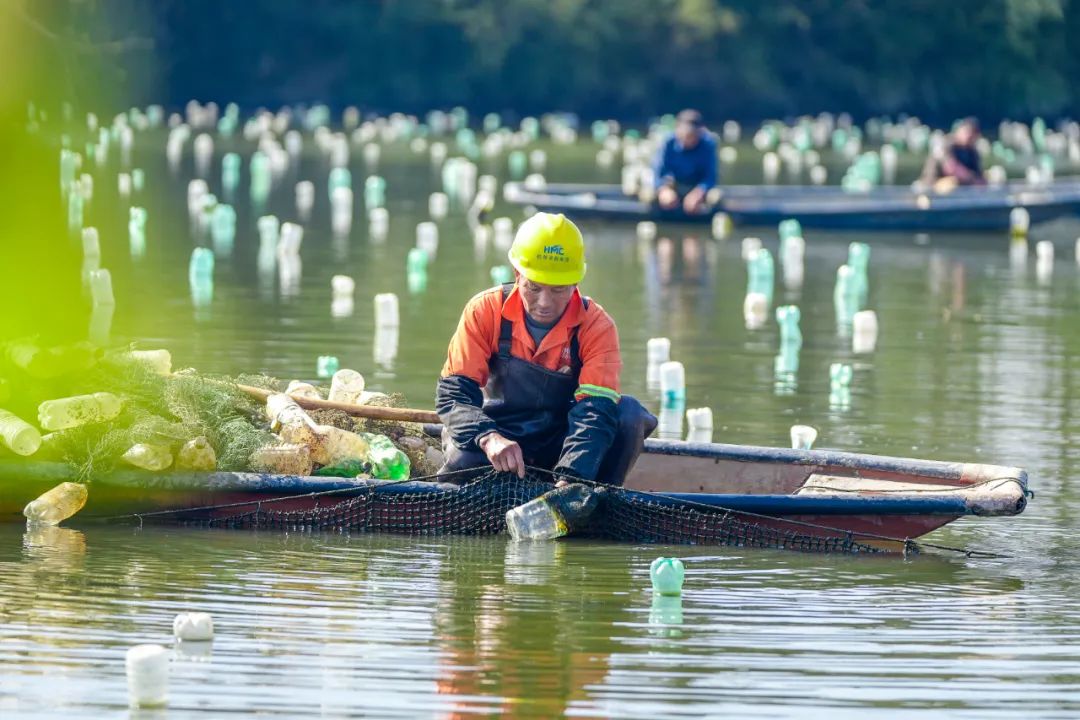
Farmers carry out pearl oyster breeding and pearl repair work
Three
Doing a good job in "local specialties" is the key to rural industrial revitalization. Looking across the province, like Duchang pearl shells, Gannan navel oranges, Nanfeng mandarin oranges, Suichuan Gougunao tea, Taihe black chickens, Guangfeng Majia pomelo and other specialty products with regional characteristics have always been favored by the market.
Duchang pearl shell products account for about 60% of the domestic market share, and the characteristic industry has attracted attention. A pearl is a city, and Duchang relies on water for food. Behind the booming pearl shell industry, there is a development path that can be used as a reference and is worth pondering.
Read the "local" word. Different natural endowments and agricultural resources form unique products, which is the natural root of local specialties. Based on this root, we must cultivate new demands, strengthen new advantages, and give full play to the multiplier effect of the integrated development of the three industries. For example, Chongqing Fuling Zhacai uses local green cabbage heads and launches a series of light-salt Zhacai products with more than 30% salt reduction. The sales volume exceeded 200 million packs in more than a month after it was launched.
Fresh water is the most precious resource in Duchang, and it is a gift from nature to the people of Duchang. Duchang has identified its comparative advantages, cultivated and expanded its traditional pillar industries, and transformed the lake area into a production area. Relying on its unique resources and doing a good job of "living off the water", it can be said that Duchang has found a new path for sustainable industrial development.
Expanding the value chain. Rural industrial competition is gradually moving from single product competition to industrial chain competition. Extending the industrial chain, building the supply chain, and improving the value chain are inevitable trends. More than 700 processing companies in Jinxiang County, Shandong Province process garlic into more than 100 products such as condiments, allicin, essential oils, capsules, etc., with a price increase of more than ten times, and exports accounting for 70% of the country.
Duchang's pearl shell industry also follows this path. In recent years, Duchang County has invested 2 billion yuan to build a pearl shell cultural industrial park, strengthen the platform, expand the leading enterprises, and strive to solve the problems of "scattered, small and chaotic". At the same time, it has accelerated the upgrading of the value chain, continuously explored multiple subdivided consumer markets such as furniture decoration, clothing buttons, and pearl decoration, and guided the transformation and upgrading of the traditional pearl shell industry with demand as the guide, and has embarked on a new development path of diversification, scale, standardization and modernization.
Embrace digitalization. Once the information barriers of product supply and demand are broken, the market will provide unlimited possibilities. To do a good job in "local products", we must keep pace with the times, seize the opportunities of digital development, integrate the "Internet +" thinking, expand new agricultural development models, broaden product sales channels, and let more and more high-quality specialty agricultural products go out of the mountains and enter the vast market.
Duchang County organically combines e-commerce with rural revitalization, introduces the new economic form of "Internet +", builds an online marketing platform, and realizes the effective connection between agricultural production and the large consumer market. In Duchang, various rural live broadcasts are flourishing, and the display cabinets are directly moved to the village and in front of the camera.
In 2022, the annual output value of the pearl shell industry will reach 900 million yuan, driving nearly 20,000 farmers to increase their income and become rich, and truly building small-variety specialty industries into large industries that drive the income of local people.
The local water and soil breed unique "local specialties". Read the "local" secret, expand the value chain, and embrace digitalization. Not only Duchang pearl shells, but all specialty industries have the opportunity to stir up endless vitality in the vast rural land.
BAOYUE PEARL wholesale natural freshwater pearls All sizes All grade with low prices.
Why Choose BAOYUE PEARL ?
1. Farm Direct Prices BAOYUE Pearls set up in 2011. We are professional Natural Pearls wholesale and Manufacturer which is located in Zhuji , Zhejiang of China. the biggest freshwater pearls Hometown in the world. we focus on suppling natural pure pearls and Cultured pearls from China, we offer lowest “Farm-Direct” Prices to our customers.
2.Natural Pearl Wholesale We are professional pure pearls supply chain Pearls Wholesale, which is experienced in providing Freshwater pearls, Akoya pearls,Tahitian pearls,South Sea peals , Freshwater pearl strands and Freshwater loose pearls with "Direct Factory Prices", BAOYUE Pure Pearl bring Chinese Factories Prices + Different Countries Service Culture under the one roof.
3.Extensive Experience BAOYUE natural pearl source didn’t just “pop up on the Internet overnight”. We have many Years working in supplying high quality pure pearls and natural pearls production and sale industry, both inside and outside China, exporting to a wide range of countries. We know what customers expect and how to consistently deliver it.
4.High Quality Guarantee One of the pitfalls to watch out for when dealing with overseas factories is when the samples get an “4A” grade but the actual products get an “A”, With BAOYUE, Our Experienced QC Check the pure pearls and orders carefully and strictly, for Every order before shipment to give you peace of mind that what you ordered is what you will receive, We always adhere to integrity-based.
5.Large Stocks Pearls NaturalPearlStrand provide abundant natural pearls Stock source of various shapes; sizes; colors and origins, BAOYUE export large quantity pure pearls around the world every year. our output is over 1 million pieces monthly. Fast Shipping: 1-2 days (Stock). So please don't worry if we can supply sufficient stock natural pearls and arrange shipping on time.
6.After-Sale Services We want and expect you to be thrilled with your purchase, but to provide you peace of mind, we offer a 30 days return policy for most of our products. any question, please feel free to contact our sales once you receive goods. we will try our best to help you, you only need to pay some express cost and we trust our Sincere service builds a bridge of our friendships.
Got a question about a product ? Need someone to help guide you through our website ?
Got feedback? Go to BAOYUE Pearl Education page to read some relevant articles about pearls. For Normal Questions, please check FAQ , and for other question, feel free to Contact Us , we make it easy for you to get in touch with us !



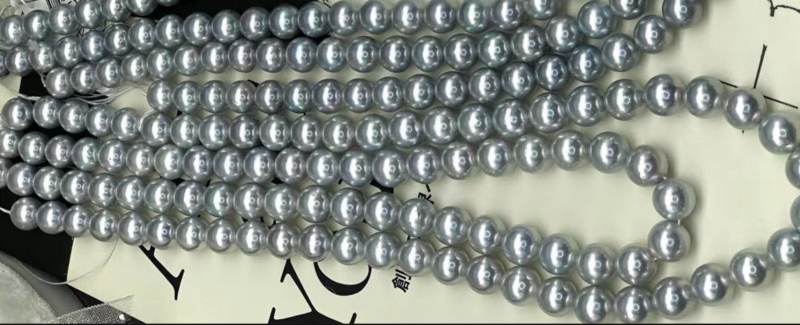 What are the differences between irradiated pearls and dyed pearls?